Live Webinar
Learn how OrthoNebraska scaled integrations without adding headcount (and achieved 30% ROI)

Guides, White papers
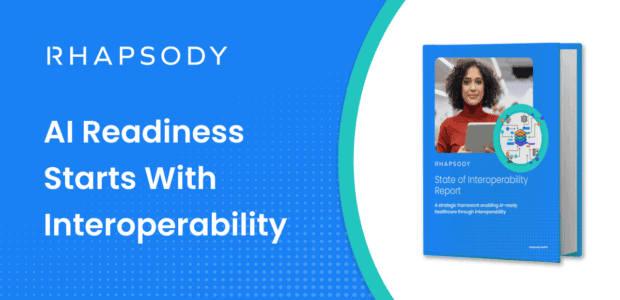
Rhapsody’s State of Interoperability Report shows interoperability remains the top barrier to scaling AI across healthcare.
Market segment
Resource type
Region
Product
Topics

Blogs

According to the Office of the National Coordinator for Information Technology (ONC), nearly 95 percent of hospitals and 90 percent of office-based physici
Read More >
Blogs

Learn more about the importance of master data management in healthcare and how Rhapsody can help your organization take control of your data.
Read More >
Blogs

Corepoint Health explores how FHIR 4 helps solve for HIT interoperability, examining terminology and data models in part one of this blog series.
Read More >
Blogs

Proper terms, descriptions, versions, and even mapping from one code set to another can help providers quickly and accurately assess existing EHR data.
Read More >
Blogs

Semantic interoperability makes healthcare data analytics possible. Learn more about the importance of clinical terminology solutions.
Read More >
Blogs

There is consistent interest in analytics for healthcare organizations – everything from population health analysis to big data analytics.
Read More >
Blogs

To integrate and share medical data within an organization and between organizations, data must be normalized to a degree where everyone agrees to what it is.
Read More >